Showing posts with label Leadership. Show all posts

Monday, 21 April 2008

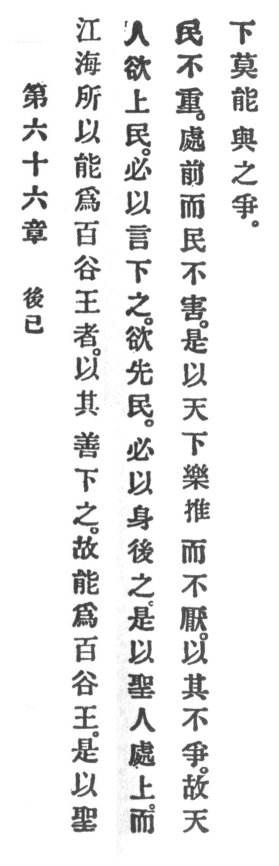
Tao Te Ching of Lao-Tzu Chapter 66


Below is the chapter from two excellent sources along with the original Chinese text. The first source is from a translation by D.T. Suzuki & Paul Carus in 1913 followed by a translation by Stephen Mitchell in 1988.

Chapter 66

1. That rivers and oceans can of the hundred valleys be kings is due to their excelling in lowliness. Thus they can of the hundred valleys be the kings.

2. Therefore the holy man, when anxious to be above the people, must in his words keep underneath them. When anxious to lead the people, he must with his person keep behind them.

3. Therefore the holy man dwells above, but the people are not burdened. He is ahead, but the people suffer no harm.

4. Therefore the world rejoices in exalting him and does not tire. Because he strives not, no one in the world will strive with him.


~~~~~~~~~~~~~~~~~~~~~~~~~~


All streams flow to the sea
because it is lower than they are.
Humility gives it its power.

If you want to govern the people,
you must place yourself below them.
If you want to lead the people,
you must learn how to follow them.

The Master is above the people,
and no one feels oppressed.
She goes ahead of the people,
and no one feels manipulated.
The whole world is grateful to her.
Because she competes with no one,
no one can compete with her.

Saturday, 19 April 2008

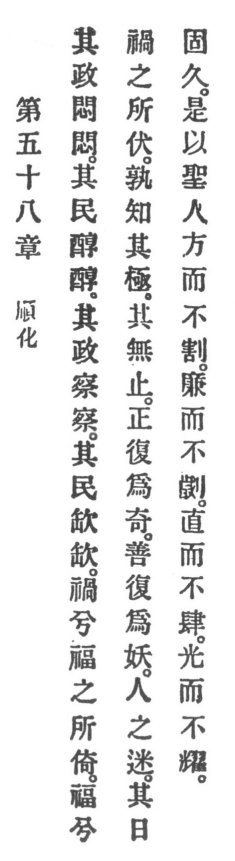
Tao Te Ching of Lao-Tzu Chapter 58


Below is the chapter from two excellent sources along with the original Chinese text. The first source is from a translation by D.T. Suzuki & Paul Carus in 1913 followed by a translation by Stephen Mitchell in 1988.

Chapter 58

1. Whose government is unostentatious, quite unostentatious, his people will be prosperous, quite prosperous. Whose government is prying, quite prying, his people will be needy, quite needy.

2. Misery, alas! rests upon happiness. Happiness, alas! underlies misery. But who foresees the catastrophe? It will not be prevented!

3. What is ordinary becomes again extraordinary. What is good becomes again unpropitious. This bewilders people, and it happens constantly since times immemorial.

4. Therefore the holy man is square but not sharp, strict but not obnoxious, upright but not restraining, bright but not dazzling.


~~~~~~~~~~~~~~~~~~~~~~~~~


If a country is governed with tolerance,
the people are comfortable and honest.
If a country is governed with repression,
the people are depressed and crafty.

When the will to power is in charge,
the higher the ideals, the lower the results.
Try to make people happy,
and you will lay the groundwork for misery.
Try to make people moral,
and you lay the groundwork for vice.

Thus the Master is content
to serve as an example
and not to impose her will.
She is pointed, but doesn't pierce.
Straightforward, but supple.
Radiant, but easy on the eyes.

Wednesday, 16 April 2008

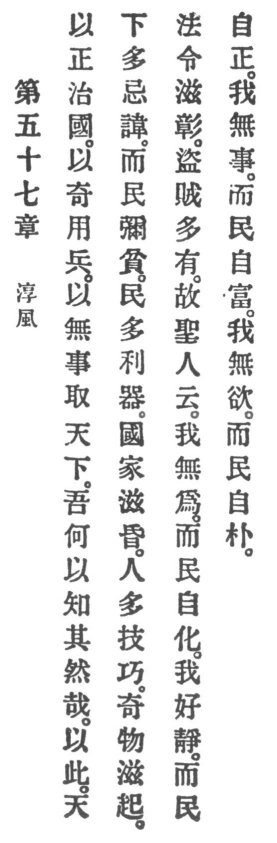
Tao Te Ching of Lao-Tzu Chapter 57


Below is the chapter from two excellent sources along with the original Chinese text. The first source is from a translation by D.T. Suzuki & Paul Carus in 1913 followed by a translation by Stephen Mitchell in 1988.

Chapter 57

1. With rectitude one governs the state; with craftiness one leads the army; with non-diplomacy one takes the empire. How do I know that it is so? Through IT.

2. The more restrictions and prohibitions are in the empire, the poorer grow the people. The more weapons the people have, the more troubled is the state. The more there is cunning and skill, the more startling events will happen. The more mandates and laws are enacted, the more there will be thieves and robbers.

3. Therefore the holy man says: I practise non-assertion, and the people of themselves reform. I love quietude, and the people of themselves become righteous. I use no diplomacy, and the people of themselves become rich. I have no desire, and the people of themselves remain simple.


~~~~~~~~~~~~~~~~~~~~~~~~~


If you want to be a great leader,
you must learn to follow the Tao.
Stop trying to control.
Let go of fixed plans and concepts,
and the world will govern itself.

The more prohibitions you have,
the less virtuous people will be.
The more weapons you have,
the less secure people will be.
The more subsidies you have,
the less self-relient people will be.

Therefore the Master says:
I let go of the law,
and people become honest.
I let go of economics,
and people become prosperous.
I let go of religion,
and people become serene.
I let go of all desire for the common good,
and the good becomes common as grass.

Sunday, 13 April 2008

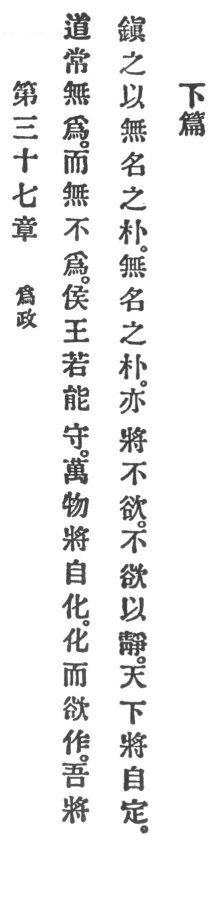
Tao Te Ching of Lao-Tzu Chapter 37


Below is the chapter from two excellent sources along with the original Chinese text. The first source is from a translation by D.T. Suzuki & Paul Carus in 1913 followed by a translation by Stephen Mitchell in 1988.

Chapter 37

1. Reason always practises non-assertion, and there is nothing that remains undone.

2. If princes and kings could keep Reason, the ten thousand creatures would of themselves be reformed. While being reformed they might yet be anxious to stir; but I would restrain them by the simplicity of the Ineffable.

3. "The simplicity of the unexpressed
Will purify the heart of lust.
Is there no lust there will be rest,
And all the world will thus be blest."


~~~~~~~~~~~~~~~~~~~~~~~~


The Tao never does anything,
yet through it all things are done.

If powerful men and women
could centre themselves in it,
the whole world would be transformed
by itself, in its natural rhythms.
People would be content
with their simple, everyday lives,
in harmony, and free of desire.

When there is no desire,
all things are at peace.

Saturday, 12 April 2008

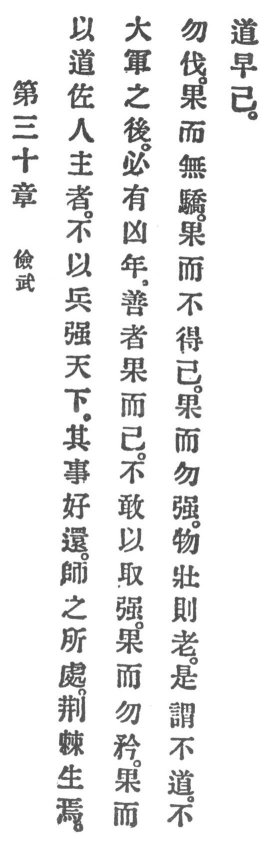
Tao Te Ching of Lao-Tzu Chapter 30


Below is the chapter from two excellent sources along with the original Chinese text. The first source is from a translation by D.T. Suzuki & Paul Carus in 1913 followed by a translation by Stephen Mitchell in 1988.

Chapter 30

1. He who with Reason assists the master of mankind will not with arms strengthen the empire. His methods invite requital.

2. Where armies are quartered briars and thorns grow. Great wars unfailingly are followed by famines. A good man acts resolutely and then stops. He ventures not to take by force.

3. Be resolute but not boastful; resolute but not haughty; resolute but not arrogant; resolute because you cannot avoid it; resolute but not violent.

4. Things thrive and then grow old. This is called un-Reason. Un-Reason soon ceases.


~~~~~~~~~~~~~~~~~~~~~~~


Whoever relies on the Tao in governing men
doesn't try to force issues
or defeat enemies by force of arms.
For every force there is a counterforce.
Violence, even well intentioned,
always rebounds upon itself.

The Master does his job
and then stops.
He understands that the universe
is forever out of control,
and thus trying to dominate events
goes against the current of the Tao.
Because he believes in himself,
he doesn't try to convince others.
Because he is content with himself,
he doesn't need others approval.
Because he accepts himself,
the whole world accepts him.

Friday, 11 April 2008

Tao Te Ching of Lao-Tzu Chapter 17


Below is the chapter from two excellent sources along with the original Chinese text. The first source is from a translation by D.T. Suzuki & Paul Carus in 1913 followed by a translation by Stephen Mitchell in 1988.

Chapter 17

1. Of great rulers the subjects do not notice the existence. To lesser ones people are attached; they praise them. Still lesser ones people fear, and the meanest ones people despise.

2. For it is said:

"If your faith be insufficient, verily, you will receive no faith."

3. How reluctantly they [the great rulers] considered their words! Merit they accomplished; deeds they performed; and the hundred families thought: "We are independent."


~~~~~~~~~~~~~~~~~~~~~


When the Master governs, the people
are hardly aware that he exists.
Next best thing is a leader who is loved.
Next, one who is feared.
The worst is one who is despised.

If you don't trust the people,
you make them untrustworthy.

The Master doesn't talk, he acts.
When his work is done,
the people say, "Amazing:
we did it, all by ourselves!"