Showing posts with label Government. Show all posts

Tuesday, 22 April 2008

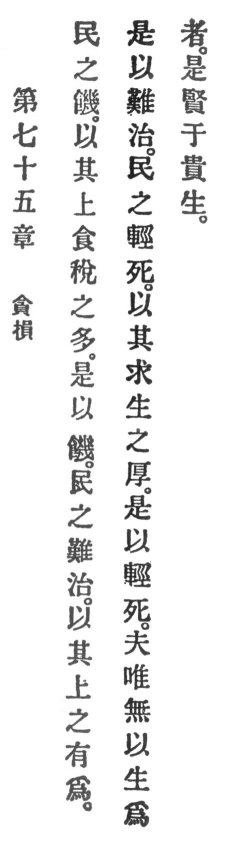
Tao Te Ching of Lao-Tzu Chapter 75


Below is the chapter from two excellent sources along with the original Chinese text. The first source is from a translation by D.T. Suzuki & Paul Carus in 1913 followed by a translation by Stephen Mitchell in 1988.

Chapter 75

1. The people hunger because their superiors consume too many taxes; therefore they hunger. The people are difficult to govern because their superiors are too meddlesome; therefore they are difficult to govern. The people make light of death on account of the intensity of their clinging to life; therefore they make light of death.

2. He who is not bent on life is worthier than he who esteems life.


~~~~~~~~~~~~~~~~~~~~~~~~


When taxes are too high,
people go hungry.
When the government is too intrusive,
people lose their spirit.

Act for the people's benefit.
Trust them; leave them alone.

Monday, 21 April 2008

Tao Te Ching of Lao-Tzu Chapter 66


Below is the chapter from two excellent sources along with the original Chinese text. The first source is from a translation by D.T. Suzuki & Paul Carus in 1913 followed by a translation by Stephen Mitchell in 1988.

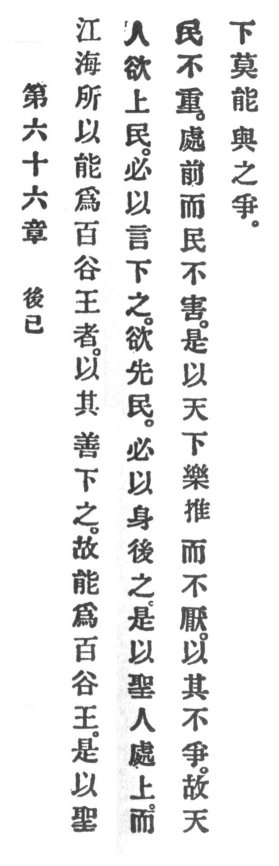
Chapter 66

1. That rivers and oceans can of the hundred valleys be kings is due to their excelling in lowliness. Thus they can of the hundred valleys be the kings.

2. Therefore the holy man, when anxious to be above the people, must in his words keep underneath them. When anxious to lead the people, he must with his person keep behind them.

3. Therefore the holy man dwells above, but the people are not burdened. He is ahead, but the people suffer no harm.

4. Therefore the world rejoices in exalting him and does not tire. Because he strives not, no one in the world will strive with him.


~~~~~~~~~~~~~~~~~~~~~~~~~~


All streams flow to the sea
because it is lower than they are.
Humility gives it its power.

If you want to govern the people,
you must place yourself below them.
If you want to lead the people,
you must learn how to follow them.

The Master is above the people,
and no one feels oppressed.
She goes ahead of the people,
and no one feels manipulated.
The whole world is grateful to her.
Because she competes with no one,
no one can compete with her.

Saturday, 19 April 2008

Tao Te Ching of Lao-Tzu Chapter 61


Below is the chapter from two excellent sources along with the original Chinese text. The first source is from a translation by D.T. Suzuki & Paul Carus in 1913 followed by a translation by Stephen Mitchell in 1988.

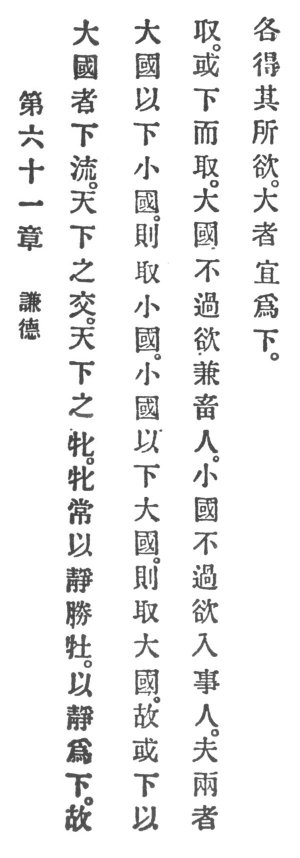
Chapter 61

1. A great state, one that lowly flows, becomes the empire's union, and the empire's wife.

2. The wife always through quietude conquers her husband, and by quietude renders herself lowly.

3. Thus a great state through lowliness toward small states will conquer the small states, and small states through lowliness toward great states will conquer great states.

4. Therefore some render themselves lowly for the purpose of conquering; others are lowly and therefore conquer.

5. A great state desires no more than to unite and feed the people; a small state desires no more than to devote itself to the service of the people; but that both may obtain their wishes, the greater one must stoop.


~~~~~~~~~~~~~~~~~~~~~~~~~~~


When a country obtains great power,
it becomes like the sea:
all streams run downward into it.
The more powerful it grows,
the greater the need for humility.
Humility means trusting the Tao,
thus never needing to be defensive.

A great nation is like a great man:
When he makes a mistake, he realises it.
Having realised it, he admits it.
Having admitted it, he corrects it.
He considers those who point out his faults
as his most benevolent teachers.
He thinks of his enemy
as the shadow that he himself casts.

If a nation is centred in the Tao,
if it nourishes its own people
and doesn't meddle in the affairs of others,
it will be a light to all nations in the world.

Tao Te Ching of Lao-Tzu Chapter 60


Below is the chapter from two excellent sources along with the original Chinese text. The first source is from a translation by D.T. Suzuki & Paul Carus in 1913 followed by a translation by Stephen Mitchell in 1988.

Chapter 60

1. Govern a great country as you would fry small fish: [neither gut nor scale them.]

2. If with Reason the empire is managed, its ghosts will not spook. Not only will its ghosts not spook, but its gods will not harm the people. Not only will its gods not harm the people, but neither will its holy men harm the people. Since neither will do harm, therefore their virtues will be combined.


~~~~~~~~~~~~~~~~~~~~~~~~~


Governing a large country
is like frying a small fish.
You spoil it with too much poking.

Centre your country in the Tao
and evil will have no power.
Not that it isn't there,
but you'll be able to step out of its way.

Give evil nothing to oppose
and it will disappear by itself.

Tao Te Ching of Lao-Tzu Chapter 59


Below is the chapter from two excellent sources along with the original Chinese text. The first source is from a translation by D.T. Suzuki & Paul Carus in 1913 followed by a translation by Stephen Mitchell in 1988.

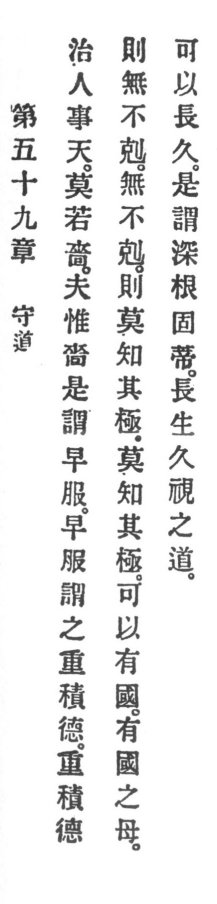
Chapter 59

1. To govern the people is the affair of heaven and there is nothing like thrift.

Now consider that thrift is said to come from early practice.

2. By early practice it is said that we can accumulate an abundance of virtue. If one accumulates an abundance of virtue then there is nothing that can not be overcome.

3. When nothing can not be overcome then no one knows his limit. When no one knows his limit one can have possession of the commonwealth.

4. Who has possession of the commonwealth's mother [thrift] may last and abide.

5. This is called the possession of deep roots and of a staunch stem. To life, to everlastingness, to comprehension, this is the way.


~~~~~~~~~~~~~~~~~~~~~~~~~~


For governing a country well
there is nothing better than moderation.

The mark of a moderate man
is freedom from his own ideas.
Tolerant like the sky,
all-pervading like sunlight,
firm like a mountain,
supple like a tree in the wind,
he has no destination in view
and makes use of anything
life happens to bring his way.

Nothing is impossible for him.
Because he has let go,
he can care for the people's welfare
as a mother cares for her child.

Tao Te Ching of Lao-Tzu Chapter 58


Below is the chapter from two excellent sources along with the original Chinese text. The first source is from a translation by D.T. Suzuki & Paul Carus in 1913 followed by a translation by Stephen Mitchell in 1988.

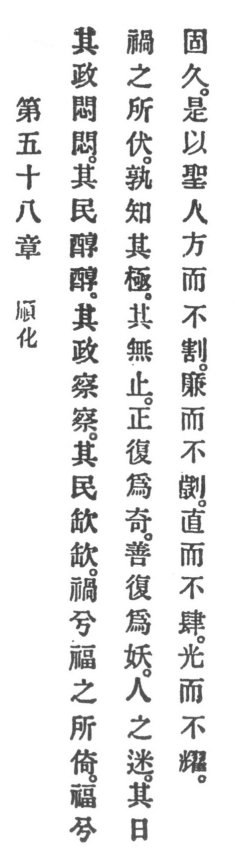
Chapter 58

1. Whose government is unostentatious, quite unostentatious, his people will be prosperous, quite prosperous. Whose government is prying, quite prying, his people will be needy, quite needy.

2. Misery, alas! rests upon happiness. Happiness, alas! underlies misery. But who foresees the catastrophe? It will not be prevented!

3. What is ordinary becomes again extraordinary. What is good becomes again unpropitious. This bewilders people, and it happens constantly since times immemorial.

4. Therefore the holy man is square but not sharp, strict but not obnoxious, upright but not restraining, bright but not dazzling.


~~~~~~~~~~~~~~~~~~~~~~~~~


If a country is governed with tolerance,
the people are comfortable and honest.
If a country is governed with repression,
the people are depressed and crafty.

When the will to power is in charge,
the higher the ideals, the lower the results.
Try to make people happy,
and you will lay the groundwork for misery.
Try to make people moral,
and you lay the groundwork for vice.

Thus the Master is content
to serve as an example
and not to impose her will.
She is pointed, but doesn't pierce.
Straightforward, but supple.
Radiant, but easy on the eyes.

Wednesday, 16 April 2008

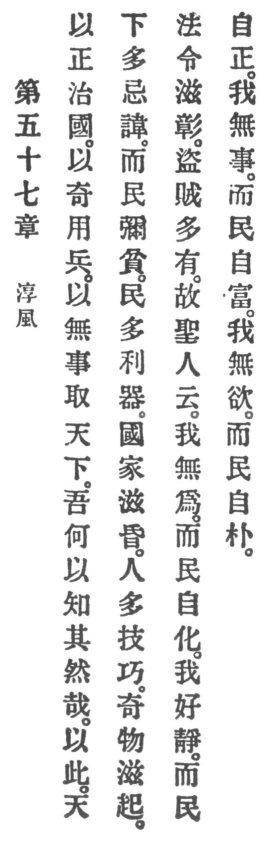
Tao Te Ching of Lao-Tzu Chapter 57


Below is the chapter from two excellent sources along with the original Chinese text. The first source is from a translation by D.T. Suzuki & Paul Carus in 1913 followed by a translation by Stephen Mitchell in 1988.

Chapter 57

1. With rectitude one governs the state; with craftiness one leads the army; with non-diplomacy one takes the empire. How do I know that it is so? Through IT.

2. The more restrictions and prohibitions are in the empire, the poorer grow the people. The more weapons the people have, the more troubled is the state. The more there is cunning and skill, the more startling events will happen. The more mandates and laws are enacted, the more there will be thieves and robbers.

3. Therefore the holy man says: I practise non-assertion, and the people of themselves reform. I love quietude, and the people of themselves become righteous. I use no diplomacy, and the people of themselves become rich. I have no desire, and the people of themselves remain simple.


~~~~~~~~~~~~~~~~~~~~~~~~~


If you want to be a great leader,
you must learn to follow the Tao.
Stop trying to control.
Let go of fixed plans and concepts,
and the world will govern itself.

The more prohibitions you have,
the less virtuous people will be.
The more weapons you have,
the less secure people will be.
The more subsidies you have,
the less self-relient people will be.

Therefore the Master says:
I let go of the law,
and people become honest.
I let go of economics,
and people become prosperous.
I let go of religion,
and people become serene.
I let go of all desire for the common good,
and the good becomes common as grass.

Tuesday, 15 April 2008

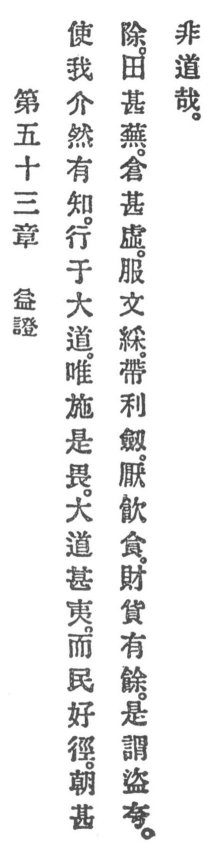
Tao Te Ching of Lao-Tzu Chapter 53


Below is the chapter from two excellent sources along with the original Chinese text. The first source is from a translation by D.T. Suzuki & Paul Carus in 1913 followed by a translation by Stephen Mitchell in 1988.

Chapter 53

1. If I have ever so little knowledge, I shall walk in the great Reason. It is but expansion that I must fear.

2. The great Reason is very plain, but people are fond of by-paths.

3. When the palace is very splendid, the fields are very weedy and granaries very empty.

4. To wear ornaments and gay clothes, to carry sharp swords, to be excessive in drinking and eating, to have a redundance of costly articles, this is the pride of robbers.

5. Surely, this is un-Reason.


~~~~~~~~~~~~~~~~~~~~~~


The great Way is easy,
yet people prefer the side paths.
Be aware when things are out of balance.
Stay centred within the Tao.

When rich speculator prosper
while farmers lose their land;
when government officials spend money
on weapons instead of cures;
when the upper class is extravagant and irresponsible
while the poor have nowhere to turn ~
all this is robbery and chaos.
It is not in keeping with the Tao.

Sunday, 13 April 2008

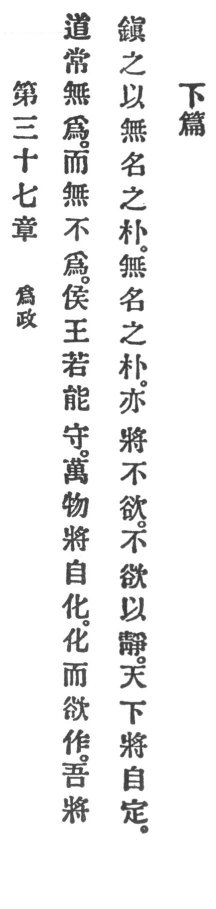
Tao Te Ching of Lao-Tzu Chapter 37


Below is the chapter from two excellent sources along with the original Chinese text. The first source is from a translation by D.T. Suzuki & Paul Carus in 1913 followed by a translation by Stephen Mitchell in 1988.

Chapter 37

1. Reason always practises non-assertion, and there is nothing that remains undone.

2. If princes and kings could keep Reason, the ten thousand creatures would of themselves be reformed. While being reformed they might yet be anxious to stir; but I would restrain them by the simplicity of the Ineffable.

3. "The simplicity of the unexpressed
Will purify the heart of lust.
Is there no lust there will be rest,
And all the world will thus be blest."


~~~~~~~~~~~~~~~~~~~~~~~~


The Tao never does anything,
yet through it all things are done.

If powerful men and women
could centre themselves in it,
the whole world would be transformed
by itself, in its natural rhythms.
People would be content
with their simple, everyday lives,
in harmony, and free of desire.

When there is no desire,
all things are at peace.